




Executive Summary
Americans often pay more for wireless service than they need to because it can be hard to identify the best price in a marketplace filled with marketing slogans for free devices, while promotions, credits, and service fees all come with complex eligibility criteria. Complicated telecom language, promotional structure, and credit offerings make it difficult to understand true costs.
This report, based on analysis of over 84,000 postpaid plan and phone deal combinations tracked daily, reveals five cost-cutting measures that can save consumers hundreds to thousands over 36 months on their wireless bills. The findings challenge common assumptions about wireless shopping, including the widely held belief that "free" phone deals offer the best value.
About Save On Wireless
From the same team that built Navi (yournavi.com), Save On Wireless (saveonwireless.com) is a wireless price comparison website that helps shoppers find real savings by comparing phone and plan deals across carriers based on true total cost, not just the best advertised prices.
Like Navi, Save On Wireless surfaces the best phone and plan deals and explains the fine print. Save On Wireless is the only price comparison tool that calculates and displays the total cost of ownership for phone deals—including plan fees, term commitments, and hidden requirements—making it easier for consumers to quickly compare options and find the true best value.
Methodology
This analysis draws from Save On Wireless's proprietary telecom pricing database, which tracks and validates postpaid phone, plan, and promotional credits daily across major U.S. carriers and authorized retailers.
Our data collection system monitors every promotional variable affecting device pricing, including trade-in values, promotional credits, plan requirements, payment terms, line minimums, and eligibility restrictions, updated continuously as carriers change offers.
For this report, we analyzed 3 months of promotional data spanning January 1, 2026, to March 31, 2026, examining an average of over 84,000 postpaid deals per day, resulting in more than 7.6M consumer scenarios for the reviewed time period for the most popular device models and plan types to identify patterns in total cost of ownership. We tracked every combination of trade-in values, plan requirements, payment terms, and other variables that impact device pricing across AT&T, T-Mobile, Verizon, Xfinity, Spectrum, Cox, and Optimum to calculate true consumer costs.
The Consumer Confusion
The wireless industry operates with significant structural complexity and opacity that leads to customer confusion. Pricing and promotional strategies vary dramatically from carrier to carrier, and the language used in phone deals and plan descriptions is often difficult for everyday shoppers to understand.
Carriers use compelling promotional slogans like "iPhone On Us" and "Galaxy On Us" that emphasize device discounts while obscuring the total cost implications of required plan upgrades, extended commitments, and restrictive eligibility terms.
This creates an environment where consumers struggle to distinguish between genuine savings and persuasive marketing, often making decisions based on advertised deals that cost them significantly more in the long run.
Five Ways to Lower Wireless Costs
1. Don't Assume "FREE" Phone Deal Slogans Like "iPhone On Us" Are the Best Deal
Free phones may sound great, but unbeknownst to consumers, they frequently cost more in the long run. While these promotions dominate carrier advertising, our analysis reveals they often represent weaker value compared to partial credit deals when the total cost of ownership is calculated.
Why "Free" Phone Deals Cost More: Higher Plan Requirements Lock You Into Premium Pricing
"Free" phone promotions typically require enrollment in higher-priced unlimited plans that cost more than other plans from the same carrier. These premium plans from AT&T, T-Mobile, and Verizon cost $25 to $50 more per month for a 1-line account than the lowest cost plans from these carriers. Over a typical 36-month device commitment, these premium plans add $960 to $3,960 to your total cost, often exceeding the value of the "free" device itself.
The Proof Is in the TCO: Total Cost of Ownership
Total Cost of Ownership (TCO) represents the complete financial picture of a phone deal:
(monthly plan cost × commitment length) + device cost - trade-in value - other promotional credits + taxes and fees = true total cost
When TCO is calculated across thousands of promotional scenarios, a clear pattern emerges: advertised device discounts tell only part of the story. The plan requirements and commitment terms associated with these promotions often drive total costs significantly higher than less aggressive device offers paired with optimally priced plans. Partial credit promotions often present a better value compared to “free phone” promotions within a given carrier and savings can be even more pronounced across carriers.
To illustrate the promotions providing the best value based on TCO in Q1 2026, the below examples compare TCO by promotion type for two of the most common consumer shopping scenarios: iPhone owners looking to trade in for the latest model and Galaxy owners looking to do the same.
Free Phone vs. Partial Credit Promotion iPhone TCO Analysis
Single-Line Switcher Trading In iPhone 14 for iPhone 17
Option 1: "iPhone On Us" Promotion
- “Free” iPhone 17 with trade-in of iPhone 14
- Plan requirement: AT&T Extra 2.0 or Premium 2.0
- Phone Retail Value: $830
- Trade-in credit: $830
- Commitment term: 36 months
- Availability dates = 3/12/26 - 3/31/26
- True Total Cost: $2,572 - $3,364
Option 2a: Partial Credit Promotion at the Same Carrier as Above
- $500 off iPhone 17 with trade-in of iPhone 14
- Plan requirement: AT&T Value 2.0
- Trade-in credit: $500
- Commitment term: 36 months
- Availability dates = 3/12/26 - 3/31/26
- True Total Cost: $2,110
NOTE: In this example, the “FREE" phone deals cost $462 - $1,254 more over 36 months than the partial credit deal, up to 59% higher overall cost.
Option 2b: Partial Credit Promotion at a Different Carrier than Above
- $600 off iPhone 17 with trade-in of iPhone 14
- Plan requirement: Xfinity Mobile Premium Unlimited
- Phone Retail Value: $830
- Trade-in credit: $600
- Commitment term: 36 months
- True Total Cost: $1,681
NOTE: When comparing all deals in the dataset for this example (trading in an iPhone 14 for a new iPhone 17), deals where the phone was "FREE" averaged $912 more in total cost over 36 months vs. deals where the phone wasn’t "FREE."
Free Phone vs. Partial Credit Promotion Galaxy TCO Analysis
Single-Line Switcher Trading In Galaxy S23 for Galaxy S26
Option 1: "Galaxy On Us" Promotion
- “Free” Galaxy S26 with trade-in of Galaxy S23
- Plan requirement: Verizon Unlimited Plus or Unlimited Ultimate
- Phone Retail Value: $900
- Trade-in credit: $900
- Commitment term: 36 months
- Availability dates = 2/25/26 - 3/31/26
- True Total Cost: $2,572 - $2,968
Option 2a: Partial Credit Promotion at the Same Carrier as Above
- $720 off Galaxy S26 with trade-in of Galaxy S23
- Plan requirement: Verizon Unlimited Welcome
- Phone Retail Value: $900
- Trade-in credit: $720
- Commitment term: 36 months
- Availability dates = 2/25/26 - 3/31/26
- True Total Cost: $2,158
NOTE: In this example, the "FREE" phone deals cost $414 - $810 more over 36 months than the partial credit deal, up to 38% higher overall cost.
Option 2b: Partial Credit Promotion at a Different Carrier Than Above
- $700 off + value of trade-in for Galaxy 26 with trade-in of Galaxy S23
- Plan requirement: Spectrum Unlimited
- Phone Retail Value: $900
- Trade-in credit: $834
- Commitment term: 36 months
- True Total Cost: $1,026
NOTE: When comparing all deals in the dataset for this example (trading in a Galaxy S23 for a Galaxy S26), deals where the phone was "FREE" averaged $1,040 more in total cost over 36 months vs. deals where the phone wasn’t "FREE."
2. Don't Keep a Device Too Long If You Want to Qualify for the Best Trade-In Deals
Consumers may think they're being frugal by extending their phone's lifespan, but carrier promotions are structured using what we call trade-in cliffs: steep drop-offs in trade-in value that can cost shoppers hundreds of dollars if they upgrade just one model generation too late.
Understanding Trade-In Cliffs
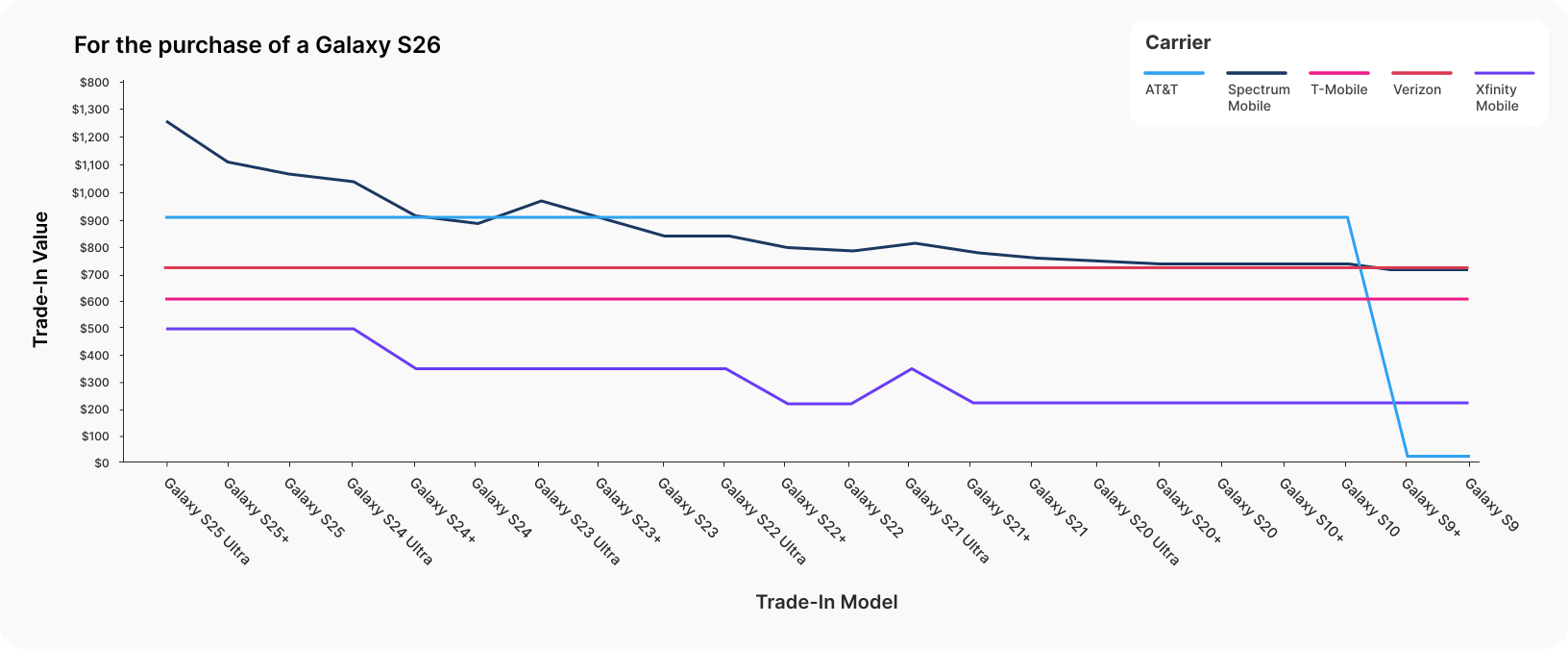
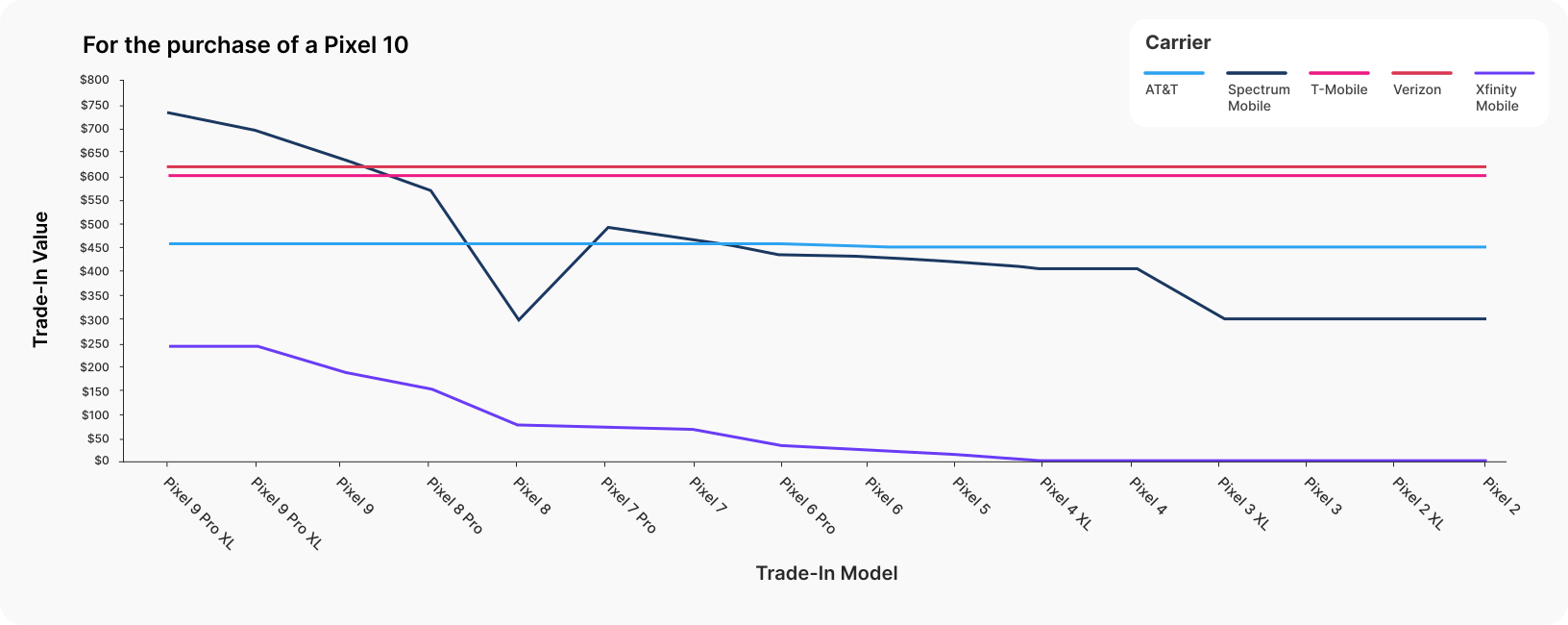
Carriers tier their trade-in credits by device model and age, creating distinct value thresholds. A phone that qualifies for $830 in trade-in credit today might drop to $350 in credit when the next model releases, not because its functional value decreased proportionally, but because it crossed a promotional eligibility threshold, a pricing phenomenon called "cliffs." These cliffs can be especially pronounced for flagship devices like iPhones and Samsung Galaxy phones, where carriers want to market high-value promotions, but limit how many consumers qualify.
Carrier promotional trade-in values for the purchase of new devices are incredibly complex, making it hard for consumers to understand the value relevant to them. Illustrating that complexity, the charts below provide a snapshot of trade-in value and new device combinations by carrier for new customers on entry-level plans on March 31, 2026. Changes to any of the above-listed criteria might mean a different value for your trade-in.
The first chart applies to the purchase of a new iPhone 17, showing that devices just one generation apart can fetch very different trade-in values. For example, T-Mobile offers $830 for iPhone 13, 14, and 15 series, but only $400 for iPhones 12 and older. Further confusing the landscape for consumers is the variance by carrier. For example, AT&T offers $500 for the iPhone 13 Pro, $350 for the iPhone 13, and <$50 for devices older than an iPhone XR. Meanwhile, Verizon offers $360 for all iPhones 15 and older, but offers more for some iPhone 16 models. Cliffs for Galaxy S26 and Pixel 10, as shown below, reflect a similar phenomenon.
.svg)
The Longer-Term Cost Calculation
While holding a phone longer appears to reduce the annual cost of device ownership, trade-in cliffs alter this math significantly. When you factor in lost trade-in value, the "savings" from extending device life by one additional year can be partially or fully offset by reduced promotional eligibility on your next upgrade.
The table below shows examples where a trade-in model lost significant value from one year to the next. Customers shopping for the latest base model iPhone (16 series) on March 31, 2025, saw $830 trade-in values for their iPhones 11, 12, 13, 14, and 15, but one year later, the trade-in values for those same devices on the current base model iPhone (17 series) were up to $480 less than their last year value depending on the carrier and trade-in model.
3. Don't Miss Family Plan Savings Because You're Not Technically Family
Family plans can save up to $46.25/line monthly compared to individual plans, but many people living in multi-phone households don't realize that "family" is a marketing term, not a requirement. Roommates, unmarried partners, adult children, or even friends can share a family plan without being related.
The Family Plan Value Gap
Carriers design family plans with per-line discounts that become more aggressive as you add lines. While a single line of premium service costs as much as $100/month in Q1 2026, that same plan tier drops to $85/line when you add a second person, and $53.75/line with four lines. On average, a single-line plan costs $53.07/line/month while a 4-line family plan costs $34.79/line/month. These savings compound annually:
- 2-line family plan vs. 2 individual lines: Saves $126/year
- 3-line family plan vs. 3 individual lines: Saves $522/year
- 4-line family plan vs. 4 individual lines: Saves $877/year
Who Qualifies for Family Plans
Despite the "family" label, carriers allow any group of people to share a plan under a single account holder. Common scenarios where consumers miss savings opportunities:
Roommates: Two or more people sharing housing who maintain separate phone accounts could consolidate to a family plan, with one person as the account holder and others paying their share via Venmo, Zelle, or similar payment methods.
Unmarried Couples: Partners living together often maintain separate accounts, mistakenly assuming that phone plans require marriage or legal partnership.
Adult Children: Parents and adult children (including those living separately) frequently maintain individual accounts when they could share a family plan, with adult children reimbursing parents for their line costs, or elderly parents reimbursing adult children.
Extended Friend Groups: Friend groups not living under the same roof can pool their service for maximum per-line discounts. The majority of carriers offering multi-line discounts cap the number of eligible lines at around 10.
4. Don't Mistake Carrier Loyalty for Savings
Long-term customers often assume their tenure earns them the best deals, but our data reveals that new customers get better deals than existing customers on identical plans. Consumers can save the most by switching carriers.
The New Customer Advantage
Carriers allocate their most aggressive promotional budgets to customer acquisition rather than retention. The result is a two-tier pricing structure for exactly the same plans and service.
New Customer Promotions Typically Include:
- Higher device trade-in credits and phone deals (averaging $119 more credit back than loyalty offers)
- Lower plan pricing for a limited-time promotional period of 12-36 months
- Waived activation or upgrade fees
- Additional perks (streaming services, accessories, gift cards)
- Offers to pay off remaining balances for existing device payments to your old carrier (up to $800 per existing financed device)
- During Q1 2026, AT&T, T-Mobile, and Verizon promotions offered a max payout of $800 per eligible device, while Spectrum Mobile offered a max payout of $500 per eligible device with the purchase of 2 or more lines
Existing Customer Promotions Typically Include:
- Lower trade-in credits or device subsidies
- Full standard plan pricing with no promotional rates
- Standard fees applied
- Fewer or no additional perks
Example: New vs. Existing Customer Savings
New Customer Offer: Trading in an iPhone XR for an iPhone 17 Pro on Verizon Unlimited Ultimate, 1-line account
- Free iPhone 17 Pro ($1,100 value), no trade-in required
- $10/mo plan credit for new customers for 36 months
- $3oo Verizon e-gift card for new customers if ordered online
- Commitment term: 36 months
- True Total Cost: $2,868
Existing Customer Offer: Trading in an iPhone XR for an iPhone 17 Pro on Verizon Unlimited Ultimate, 1-line account
- $300 off iPhone 17 Pro with trade-in of iPhone XR
- No plan credit
- No gift card
- Commitment term: 36 months
- True Total Cost: $4,364
NOTE: In this one example, albeit the most extreme in our Q1 dataset, an existing customer would end up paying $1,496 more over 36 months than a new customer for the same product.
The Loyalty Tax
For identical plans and phones, existing loyal customers usually pay more than new customers. On average, existing customers pay $4.83/line/month (or $58/line/year) for their plan and phone purchase more than new customers on identical plans, with identical new phone purchases.
When Loyalty Pays (Rarely)
Limited scenarios exist where long-term customer status provides value:
- "Grandfathered" legacy plans with features no longer offered (unlimited high-speed hotspot, specific international roaming, etc.)
- Corporate discounts or employer partnerships that stack better on older plan structures
- Promotional pricing and "free lines" that are "locked in" from previous eras that remain below current rates
The Switching Consideration
While switching carriers provides access to new customer promotions, consumers should consider the following:
- Early termination fees if device financing remains (though many carriers will now pay up to $800 per device to help you pay off this cost to your old carrier)
- Time and complexity of porting numbers and transferring service
- Risk of service disruption during the transition
- Need to re-evaluate coverage in your specific locations
5. Don't Underestimate the Value in Bundling Wireless and Home Internet Services
Consumers who use a different provider for their home internet than for their wireless service should 1) check if their internet service provider (ISP) offers wireless service, and 2) inquire about bundled service discounts. Based on Q1 2026 promotions, bundling home internet and wireless service can save up to $480 in the first year of mobile service.
Internet Service Providers Offering Wireless Bundling Discounts
During Q1 2026 (and throughout 2025), internet service providers Xfinity and Spectrum incentivized their home internet customers to switch to their mobile offering by providing significant single-line discounts during the first year of service.
Xfinity Limited-Time Bundled Offer Savings
Deal: Xfinity + Xfinity Mobile Single Line Savings with an Entry Unlimited Plan
- Existing and new Xfinity Home Internet customers who switch to Xfinity Mobile and sign up for Unlimited get their first line of phone service for free for one year, a savings of $480
- After the promotional period ends, the monthly fee reverts to $40/month, approximately $10 less monthly than the most comparable unlimited plan from AT&T, T-Mobile, and Verizon
Deal: Xfinity + Xfinity Mobile Single Line Savings with a Premium Unlimited Plan
- Existing and new Xfinity Home Internet customers who switch to Xfinity Mobile and sign up for Premium Unlimited get their first line of phone service for $10/month for one year, a savings of $480
- After the promotional period ends, the monthly fee reverts to $50/month, approximately $20 less monthly than the most comparable unlimited plan from AT&T, T-Mobile, and Verizon
Spectrum Limited-Time Bundled Offer Savings
Deal: Spectrum + Spectrum Mobile Single Line Savings with an Entry Unlimited Plan
- Existing and new Spectrum Home Internet customers who switch to Spectrum Mobile and sign up for Unlimited get their first line of phone service for free for one year, a savings of $480
- After the promotional period ends, the monthly fee reverts to $40/month, approximately $10 less monthly than the most comparable unlimited plan from AT&T, T-Mobile, and Verizon
Deal: Spectrum + Spectrum Mobile Single Line Savings with a Premium Unlimited Plan
- Existing and new Spectrum Home Internet customers who switch to Spectrum Mobile and sign up for Unlimited Plus get their first line of phone service for $10/month for one year, a savings of $480
- After the promotional period ends, the monthly fee reverts to $50/month, approximately $20 less monthly than the most comparable unlimited plan from AT&T, T-Mobile, and Verizon
Wireless Service Providers Offering Internet Bundling Discounts
During Q1 2026, AT&T, T-Mobile, and Verizon incentivized their wireless customers to switch to their home internet services by providing broadband discounts that do not expire.
AT&T Bundled Offer Savings
Deal: AT&T Wireless + AT&T Home Internet
- Existing and new AT&T Wireless customers who bundle with AT&T for home internet get 20% discount on home internet service
- For 1Gig offering, this provides $18/mo savings
- Bundled discount does not expire
T-Mobile Bundled Offer Savings
Deal: T-Mobile Wireless + T-Mobile Home Internet
- Existing and new T-Mobile wireless customers who bundle with T-Mobile for home internet get $10 off/mo for fiber or $20 off/mo for fixed wireless
- Bundled discount does not expire
Verizon Bundles Offer Savings
Deal: Verizon Wireless + Verizon Home Internet
- Existing and new Verizon wireless customers who bundle with Verizon for home internet get $15 off/mo
- Bundled discount does not expire
The Bottom Line: Significant Savings Potential
By taking the cost-cutting measures outlined in this report, American wireless postpaid consumers can reduce their annual costs significantly.
The savings compound over multi-year periods and across multiple lines, representing a meaningful reduction in wireless spending over a typical 36-month device commitment.
The wireless industry's complexity and opacity create an environment where well-informed consumers can gain substantial financial advantages. By focusing on the total cost of ownership, understanding promotional structures, and periodically reviewing alternatives, shoppers can cut through marketing language and identify impactful ways to save.
Contact Information
For media inquiries or data requests, contact: Adeeva Fritz | Brian Kramer
press@saveonwireless.com
About the Company
Navi is a next-gen telecom intelligence and growth company operating consumer-facing comparison platforms, including yournavi.com and saveonwireless.com, and providing data and insights services to telecom operators. The company tracks and validates 3+ million postpaid, prepaid, and broadband pricing, promotion, and product data points daily to help consumers and industry partners navigate the complex telecom market.
In XX% of scenarios analyzed, the promotion with the lowest total cost of ownership was not the deal advertising the steepest device discount. Shoppers optimizing for device savings rather than total cost overpaid by an average of $XXX per device.
In XX% of scenarios analyzed, the promotion with the lowest total cost of ownership was not the deal advertising the steepest device discount. Shoppers optimizing for device savings rather than total cost overpaid by an average of $XXX per device.